
 Home page
  Relic Commander News
  Login to the game
  Create an account
  Account management
  Community
  Roadmap
  Statistics
  Contact us
  Rules, Privacy & FAQ
 Relic Commander - Articles
Devlog #03 - Vision, Scans, Mining and Distortium Signatures
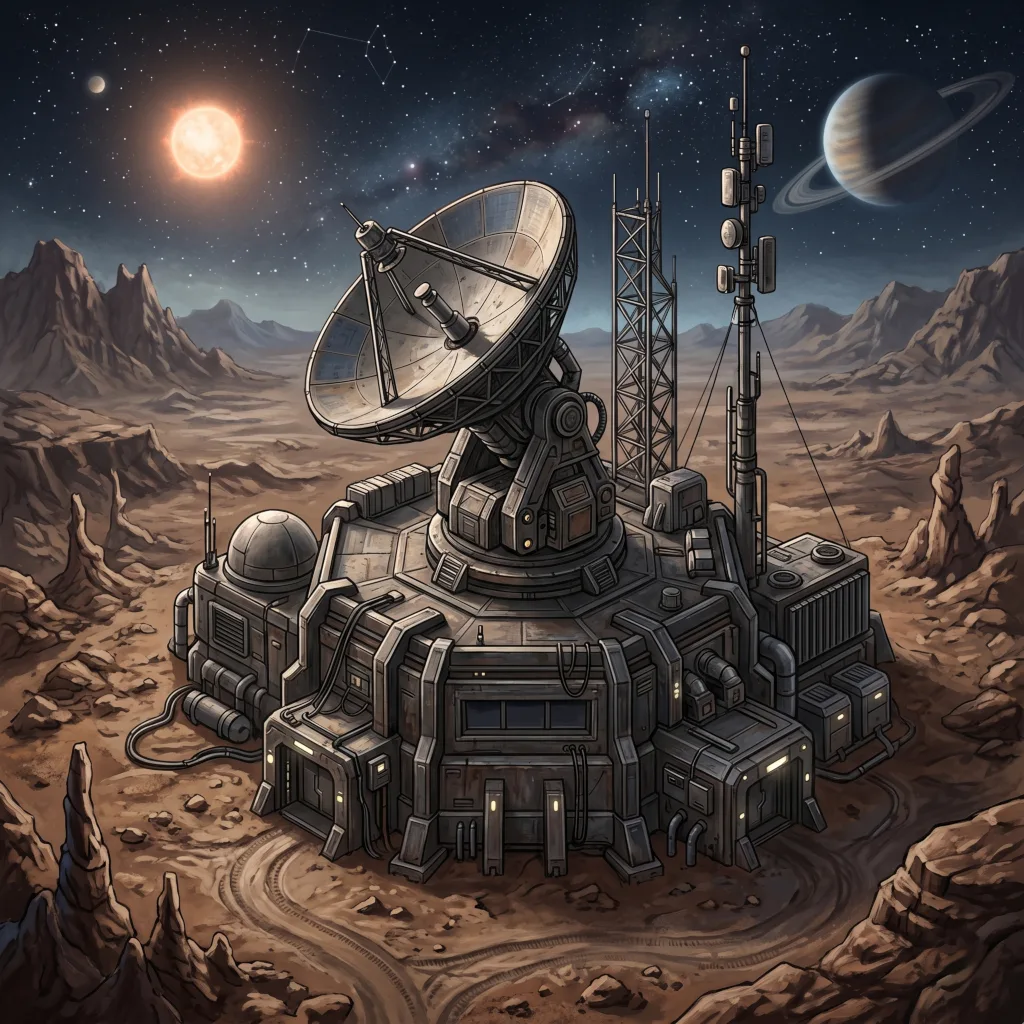
The development of **Relic Commander** is progressing well, with a major series of improvements around the universe view, fleets, and strategic intelligence.
After cargo and bay transfers, fleet movement, and space mining, I worked on a very important step: making the universe more readable, more understandable, and above all more strategic.
## Universe view and fleet display
The universe view now displays fleets present in visible sectors. Sectors keep their visual identity — empty space, asteroids, planets, stars — but can now also display detected presences through colored labels.
The player’s own fleets are visible directly on the map, with the ability to quickly open a fleet from the relevant sector. Allied, neutral, and enemy fleets have a more limited display, adapted to the game’s intelligence logic.
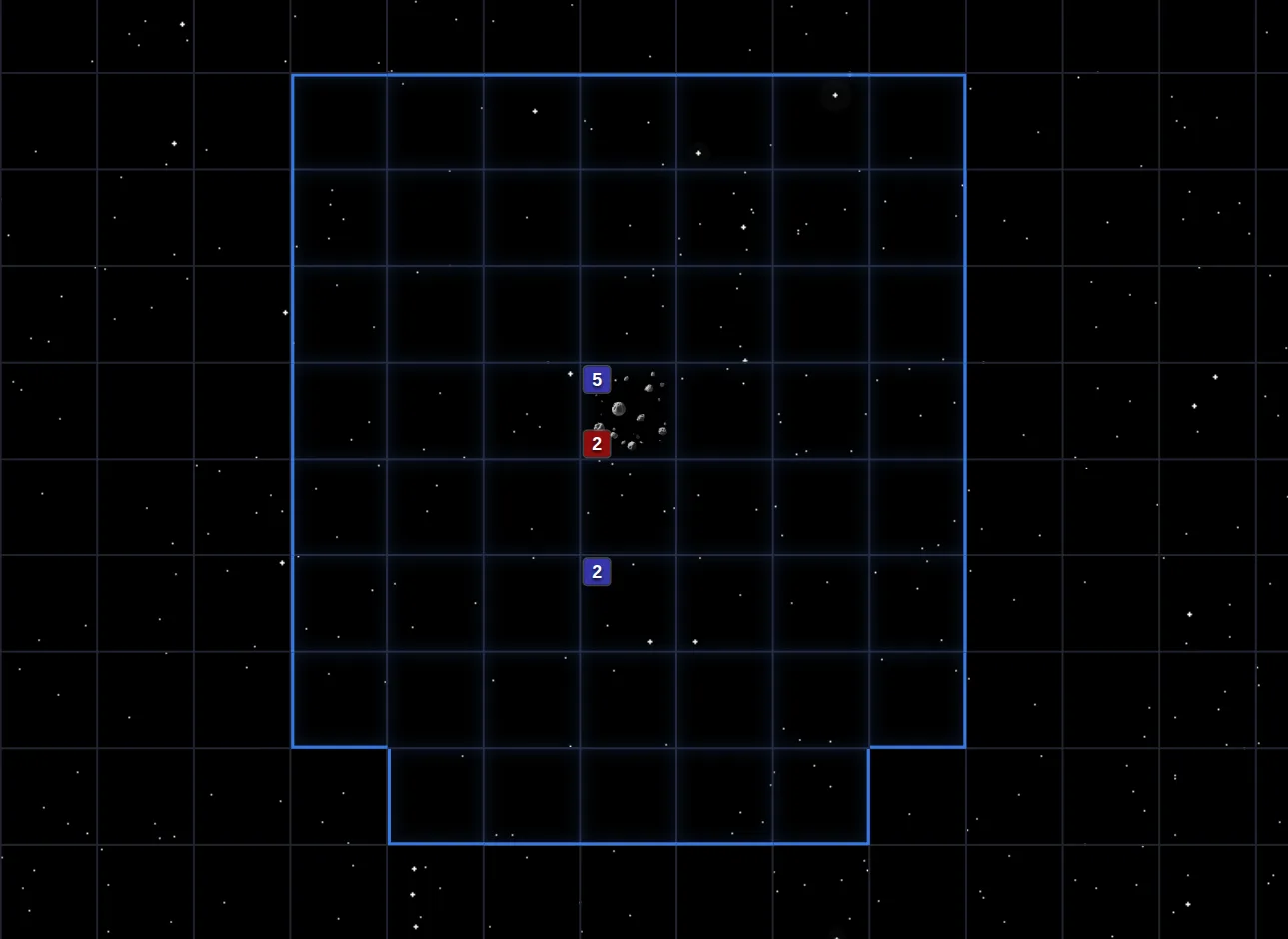
The goal is to give players a better understanding of their surroundings, without revealing every piece of information for free.
## Visible fleet movement
The movement of our fleets is now visible in the universe view. The route displays both the sectors already crossed and the sectors still planned, making it much easier to follow a fleet’s progression.
This visualization makes movement clearer, especially when multiple fleets are active or when routes span several sectors.
I also added a new strategic layer: **Distortium signatures**.
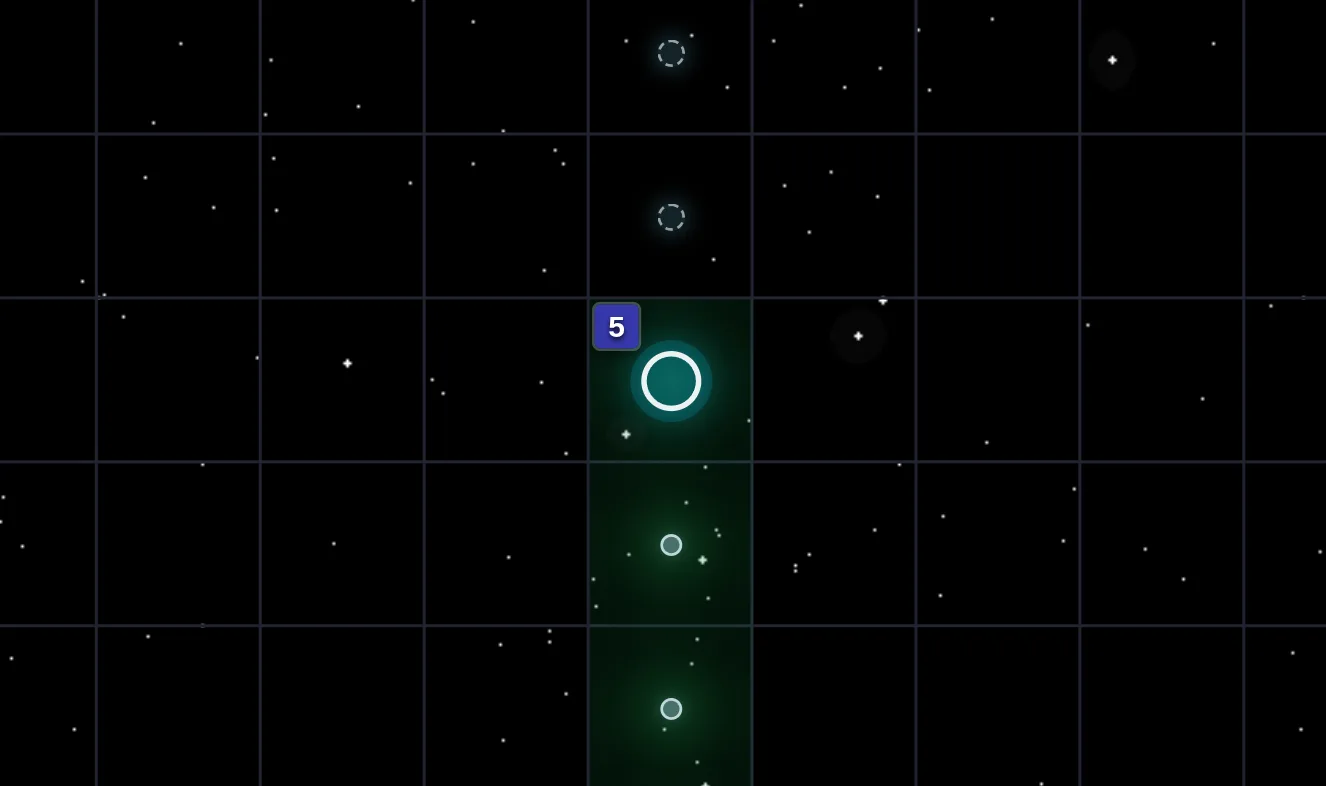
Every fleet passage leaves a temporary disturbance in the sectors it crosses. These disturbances feed a heatmap visible in the universe view. The more a zone is crossed by fleets, the stronger its signature becomes.
This information does not directly reveal who is passing through, nor exactly where a fleet is going, but it can help identify frequently used routes, logistical corridors, areas of activity, or potential ambush points.
Every journey leaves a trace. And those traces can become valuable intelligence.
## Fog of war and planetary radar
The **fog of war** is now in place. Vision depends on the detection range of fleets and planets. In the universe view, this range is represented by a blue outline, making it easier to understand which areas are currently covered.
Fleets do not provide vision while moving, which reinforces the importance of positioning, surveillance, and fixed detection sources.
The **planetary radar** building has also been implemented. Its detection range depends on its level. A planet equipped with a radar therefore becomes a strategic source of vision around its sector.
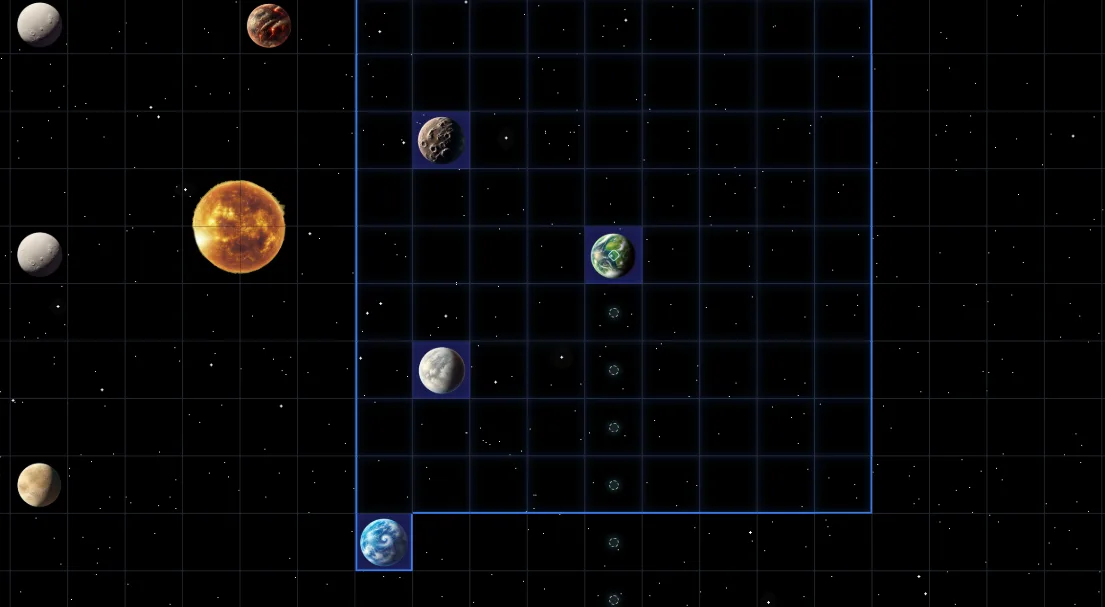
This mechanic begins to establish a real logic of territorial control: see, monitor, detect, then act.
## Fleet scan and PulseProbe Mk.I
The scan system has been added as planned.
Without a scan, a foreign fleet only reveals its basic visible information: owner, current action, number of ships, chassis, and formation. To obtain more precise information, an active scan must be launched from a fleet located in the same sector.
The first scan component, the **PulseProbe Mk.I**, is now integrated into the game. It has a scan score of **40** and is unlocked through research.
Scanning progresses turn after turn. The targeted fleet is warned as soon as the scan begins, making the action very visible and potentially provocative. Depending on the scan progress reached, the scan report can reveal several levels of information:
* global fleet statistics;
* installed modules;
* cargo hold and bay contents at maximum scan level.
Scan reports can be accessed from notifications and are updated as the scan progresses.
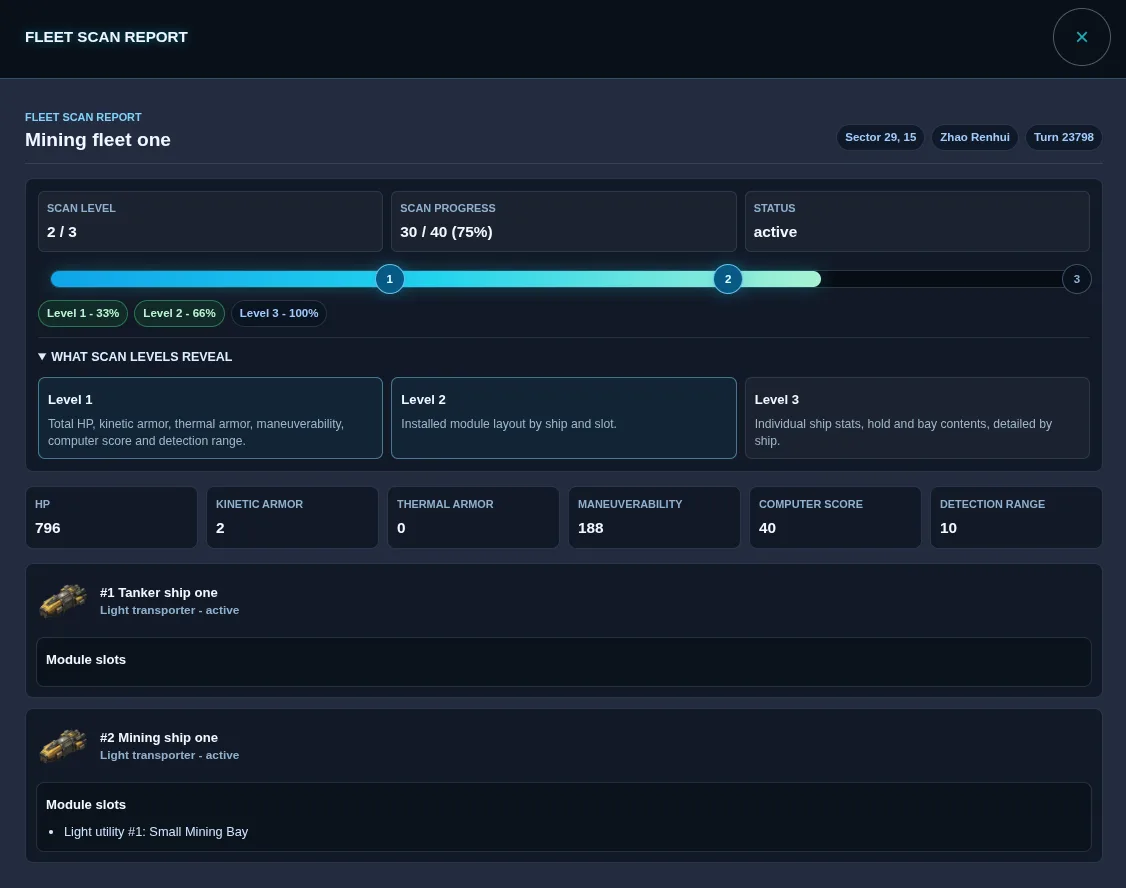
Scanning therefore becomes an active intelligence tool, but also a political signal: scanning a fleet is not a neutral act.
## Space mining and asteroid sectors
Space mining is also functional.
A fleet equipped with mining modules can exploit an asteroid sector. Each active module extracts a type of rock according to the sector’s hidden ratio: **Common Rock**, **Mineralized Rock**, or **Crystalline Rock**.
Space mining strengthens the game’s economic loop by giving fleets their first direct productive role in the universe.
This foundation will also support future automated routines, especially with the **Fleet Commander**, which will later allow more advanced fleet behaviors to be programmed.
## Conclusion
Relic Commander continues to take shape, step by step, system after system.
With vision, fog of war, Distortium signatures, scans, and space mining, the universe becomes more alive, more readable, and more strategic.
The next step will be to continue consolidating these systems in preparation for future fleet mechanics, automation, detailed visualization, and finally, combat.